|
FIDE Laws of Chess
|
|
The FIDE Laws of Chess cover over-the-board play.
The English text is the authentic
version of the Laws of Chess, which was adopted at the
75th FIDE Congress at Calvia (Mallorca), October 2004,
coming into force on 1 July 2005.
In these Laws the words `he`,
`him` and `his` include `she` and `her`.
|
|
PREFACE
The Laws of Chess cannot cover all
possible situations that may arise during a game, nor
can they regulate all administrative questions. Where
cases are not precisely regulated by an Article of the
Laws, it should be possible to reach a correct decision
by studying analogous situations, which are discussed in
the Laws. The Laws assume that arbiters have the
necessary competence, sound judgement and absolute
objectivity. Too detailed a rule might deprive the
arbiter of his freedom of judgement and thus prevent him
from finding the solution to a problem dictated by
fairness, logic and special factors.
FIDE appeals to all chess players and federations to
accept this view.
A member federation is free to introduce more detailed
rules provided they:
a. do not conflict in any way with the official FIDE
Laws of Chess
b. are limited to the territory of the federation in
question; and
c. are not valid for any FIDE match, championship or
qualifying event, or for a FIDE title or rating
tournament.
BASIC RULES OF PLAY
Article 1: The nature and objectives of the
game of chess
1.1 The game of chess is played between two opponents
who move their pieces alternately on a square board
called a `chessboard`. The player with the white pieces
commences the game. A player is said to `have the move`,
when his opponent`s move has been âmadeâ.
1.2 The objective of each player is to place the
opponent`s king `under attack` in such a way that the
opponent has no legal move. The player who achieves this
goal is said to have `checkmated` the opponent`s king
and to have won the game. Leaving oneâs own king under
attack, exposing oneâs own king to attack and also
âcapturingâ the opponentâs king are not allowed.
The opponent whose king has been checkmated has lost the
game.
1.3 If the position is such that neither player can
possibly checkmate, the game is drawn.
|
| Article 2: The
initial position of the pieces on the chessboard |
| 2.1 |
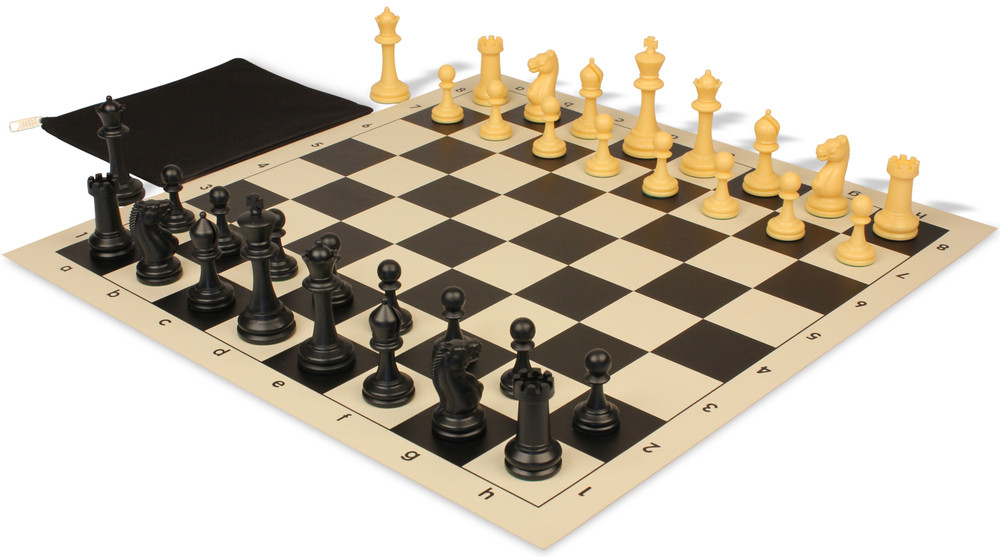
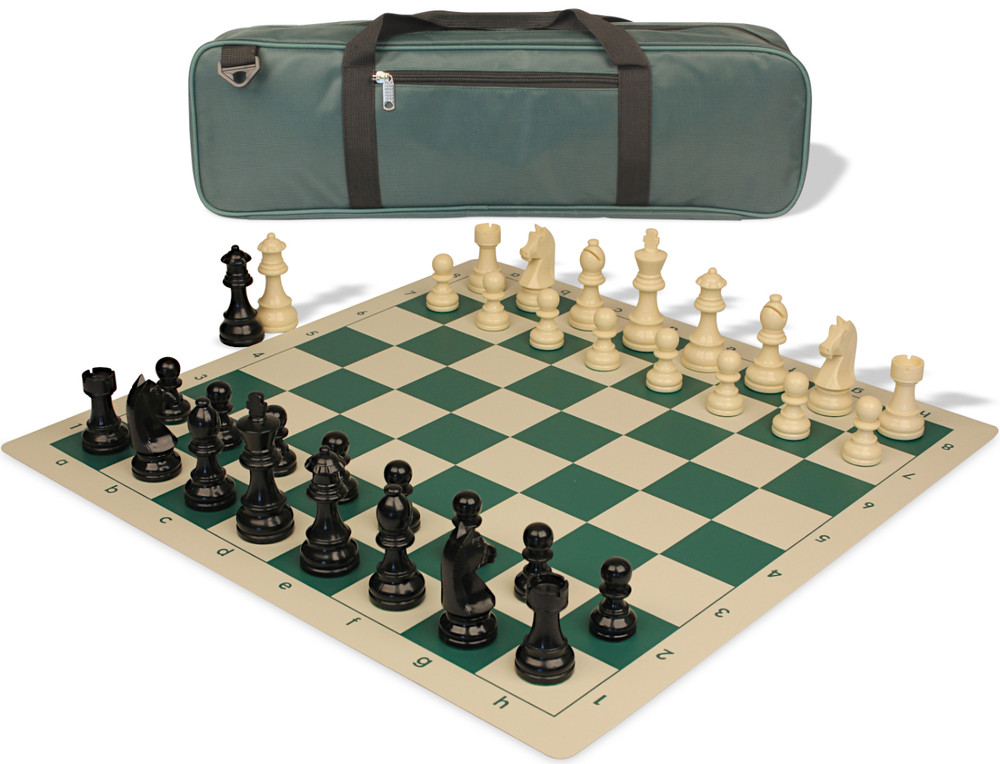
The chessboard is composed of an 8x8
grid of 64 equal squares alternately light (the `white`
squares) and dark (the `black` squares).
The chessboard is placed between the players in such a
way that the near corner square to the right of the
player is white.
|
| 2.2 |
At the beginning of the game one
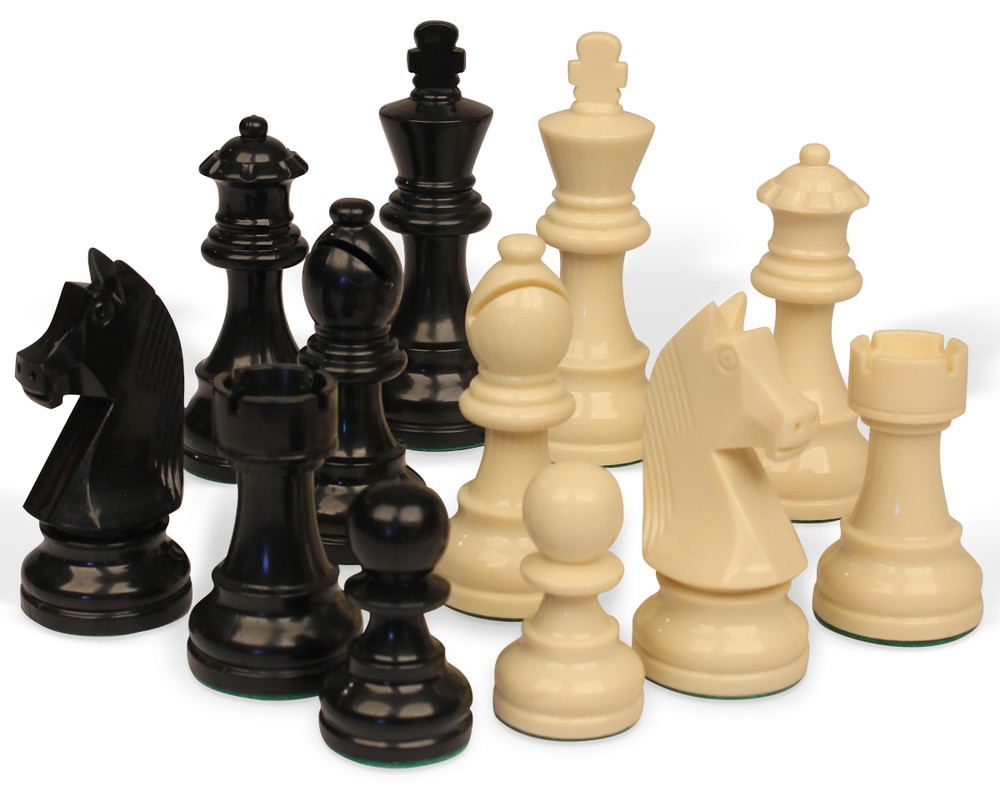
player has 16 light-coloured pieces (the `white`
pieces); the other has 16 dark-coloured pieces (the
`black` pieces):
These pieces are as follows:
| A white king, usually indicated by the symbol |
 |
| A white queen, usually indicated by the symbol |
 |
| Two white rooks, usually indicated by the
symbol |
 |
| Two white bishops, usually indicated by the
symbol |
 |
| Two white knights, usually indicated by the
symbol |
 |
| Eight white pawns, usually indicated by the
symbol |
 |
| A black king, usually indicated by the symbol |
 |
| A black queen, usually indicated by the symbol |
 |
| Two black rooks, usually indicated by the
symbol |
 |
| Two black bishops, usually indicated by the
symbol |
 |
| Two black knights, usually indicated by the
symbol |
 |
| Eight black pawns, usually indicated by the
symbol |
 |
|
| 2.3 |
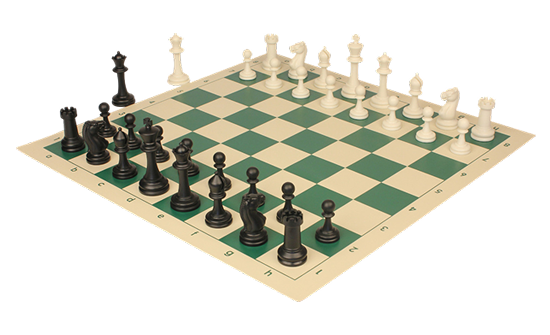
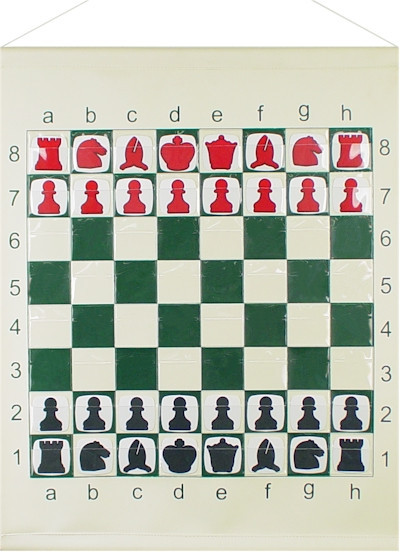
The initial position of the pieces on
the chessboard is as follows:

|
| 2.4 |
The eight vertical columns of squares
are called `files`. The eight horizontal rows of squares
are called ranks`. A straight line of squares of the
same colour, touching corner to corner, is called a
`diagonal`.
|
| Article 3: The moves
of the pieces |
| 3.1 |
It is not permitted to move a piece
to a square occupied by a piece of the same colour. If a
piece moves to a square occupied by an opponent`s piece
the latter is captured and removed from the chessboard
as part of the same move. A piece is said to attack an
opponent`s piece if the piece could make a capture on
that square according to Articles 3.2 to 3.8. A piece is
considered to attack a square, even if such a piece is
constrained from moving to that square because it would
then leave or place the king of its own colour under
attack.
|
| 3.2 |
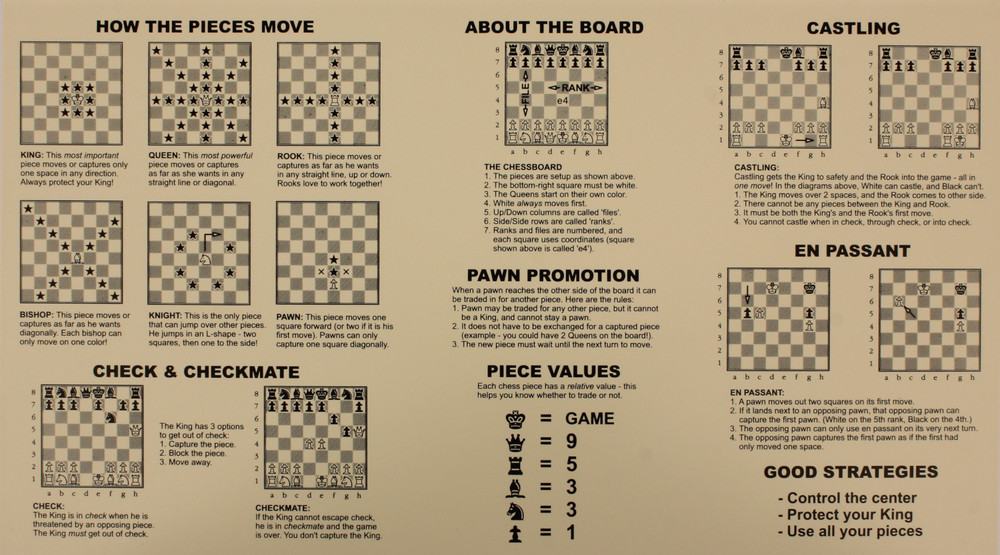
The bishop may move to any square
along a diagonal on which it stands.

|
| 3.3 |
The rook may move to any square along
the file or the rank on which it stands.

|
| 3.4 |
The queen may move to any square
along the file, the rank or a diagonal on which it
stands.

|
| 3.5 |
When making these moves the bishop,
rook or queen may not move over any intervening pieces.
|
| 3.6 |
The knight may move to one of the
squares nearest to that on which it stands but not on
the same rank, file or diagonal.

|
| 3.7 |
-
The pawn may move forward to the
unoccupied square immediately in front of it on the
same file, or
-
on its first move the pawn may
move as in (a); alternatively it may advance two
squares along the same file provided both squares
are unoccupied, or
-
the pawn may move to a square
occupied by an opponent`s piece, which is diagonally
in front of it on an adjacent file, capturing that
piece.

-
Ad. A pawn attacking a square
crossed by an opponent`s pawn which has advanced two
squares in one move from its original square may
capture this opponent`s pawn as though the latter
had been moved only one square. This capture is only
legal on the move following this advance and is
called an `en passant` capture.

-
When a pawn reaches the rank
furthest from its starting position it must be
exchanged as part of the same move for a new queen,
rook, bishop or knight of the same colour. The
player`s choice is not restricted to pieces that
have been captured previously. This exchange of a
pawn for another piece is called `promotion` and the
effect of the new piece is immediate.
|
| 3.8 |
a. There are two different ways of moving
the king, by:
-
moving to any adjoining square
not attacked by one or more of the opponent`s
pieces.
or
-
`castling`. This is a move of the
king and either rook of the same colour on the same
rank, counting as a single move of the king and
executed as follows: the king is transferred from
its original square two squares towards the rook,
then that rook is transferred to the square the king
has just crossed.

(1) The right for castling has been lost:
-
if the king has already
moved, or
-
with a rook that has already
moved
(2) Castling is prevented temporarily
-
if the square on which the
king stands, or the square which it must cross,
or the square which it is to occupy, is attacked
by one or more of the opponent`s pieces.
-
if there is any piece between
the king and the rook with which castling is to
be effected.
|
| 3.9 |
The king is said to be `in check` if
it is attacked by one or more of the opponent`s pieces,
even if such pieces are constrained from moving to that
square because they would then leave or place their own
king in check. No piece can be moved that will either
expose the king of the same colour to check or leave
that king in check.
|
| Article 4: The act of
moving the pieces |
| 4.1 |
Each move must be made with one hand
only.
|
| 4.2 |
Provided that he first expresses his
intention (e.g. by saying "j`adoube" or
"I adjust"), the player having the move may
adjust one or more pieces on their squares.
|
| 4.3 |
Except as provided in Article 4.2, if
the player having the move deliberately touches on the
chessboard
-
one or more of his own pieces, he
must move the first piece touched that can be moved,
or
-
one or more of his opponent`s
pieces, he must capture the first piece touched,
which can be captured, or
-
one piece of each colour, he must
capture the opponent`s piece with his piece or, if
this is illegal, move or capture the first piece
touched which can be moved or captured. If it is
unclear, whether the player`s own piece or his
opponent`s was touched first, the player`s own piece
shall be considered to have been touched before his
opponent`s.
|
| 4.4 |
-
If a player deliberately touches
his king and rook he must castle on that side if it
is legal to do so.
-
If a player deliberately touches
a rook and then his king he is not allowed to castle
on that side on that move and the situation shall be
governed by Article 4.3(a).
-
If a player, intending to castle,
touches the king or king and rook at the same time,
but castling on that side is illegal, the player
must make another legal move with his king which may
include castling on the other side. If the king has
no legal move, the player is free to make any legal
move.
-
If a player promotes a pawn, the
choice of the piece is finalised, when the piece has
touched the square of promotion.
|
| 4.5 |
If none of the pieces touched can be
moved or captured, the player may make any legal move.
|
| 4.6 |
When, as a legal move or part of a
legal move, a piece has been released on a square, it
cannot then be moved to another square. The move is
considered to have been made when all the relevant
requirements of Article 3 have been fulfilled.
-
in the case of a capture, when
the captured piece has been removed from the
chessboard and the player, having placed his own
piece on its new square, has released this capturing
piece from his hand;
-
in the case of castling, when the
player`s hand has released the rook on the square
previously crossed by the king. When the player has
released the king from his hand, the move is not yet
made, but the player no longer has the right to make
any move other than castling on that side, if this
is legal;
-
in the case of the promotion of a
pawn, when the pawn has been removed from the
chessboard and the player`s hand has released the
new piece after placing it on the promotion square.
If the player has released from his hand the pawn
that has reached the promotion square, the move is
not yet made, but the player no longer has the right
to play the pawn to another square.
|
| 4.7 |
A player forfeits his right to a
claim against his opponent`s violation of Article 4.3 or
4.4, once he deliberately touches a piece.
|
| Article 5: The
completion of the game |
| 5.1 |
-
The game is won by the player who
has checkmated his opponent`s king. This immediately
ends the game, provided that the move producing the
checkmate position was a legal move.
-
The game is won by the player
whose opponent declares he resigns. This immediately
ends the game.
|
| 5.2 |
-
The game is drawn when the player
to move has no legal move and his king is not in
check. The game is said to end in `stalemate`. This
immediately ends the game, provided that the move
producing the stalemate position was legal.
-
The game is drawn when a position
has arisen in which neither player can checkmate the
opponent`s king with any series of legal moves. The
game is said to end in a `dead position`. This
immediately ends the game, provided that the move
producing the position was legal.
-
The game is drawn upon agreement
between the two players during the game. This
immediately ends the game. (See Article 9.1)
-
The game may be drawn if any
identical position is about to appear or has
appeared on the chessboard at least three times.
(See Article 9.2)
-
The game may be drawn if each
player has made at least the last 50 consecutive
moves without the movement of any pawn and without
any capture. (See Article 9.3)
|
| COMPETITION RULES |
| Article 6: The chess
clock |
| 6.1 |
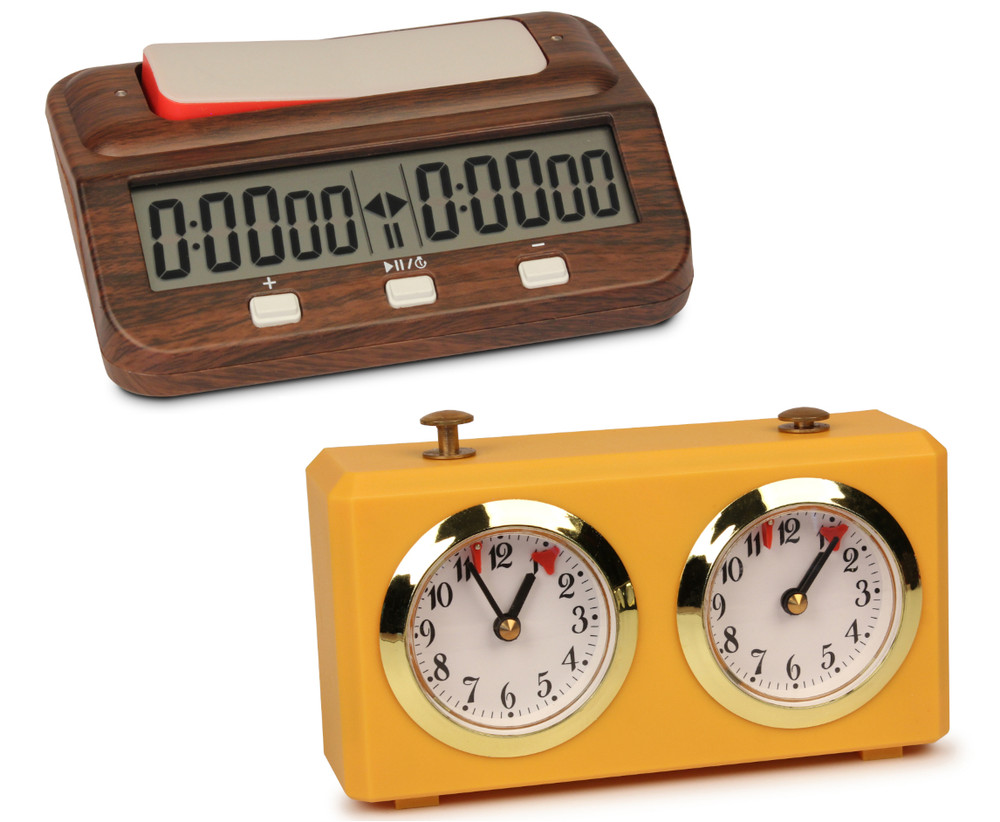
`Chess clock` means a clock with two
time displays, connected to each other in such a way
that only one of them can run at one time.
`Clock` in the Laws of Chess means one of the two time
displays.
`Flag fall` means the expiration of the allotted time
for a player.
|
| 6.2 |
-
When using a chess clock, each
player must make a minimum number of moves or all
moves in an allotted period of time and/or may be
allocated an additional amount of time with each
move. All these must be specified in advance.
-
The time saved by a player during
one period is added to his time available for the
next period, except in the `time delay` mode.
In the time delay mode both players receive an
allotted `main thinking time`. Each player also
receives a `fixed extra time` with every move. The
countdown of the main time only commences after the
fixed time has expired. Provided the player stops
his clock before the expiration of the fixed time,
the main thinking time does not change, irrespective
of the proportion of the fixed time used.
|
| 6.3 |
Each time display has a `flag`.
Immediately after a flag falls, the requirements of
Article 6.2(a) must be checked.
|
| 6.4 |
Before the start of the game the
arbiter decides where the chess clock is placed.
|
| 6.5 |
At the time determined for the start
of the game the clock of the player who has the white
pieces is started.
|
| 6.6 |
If neither player is present
initially, the player who has the white pieces shall
lose all the time that elapses until he arrives; unless
the rules of the competition specify or the arbiter
decides otherwise.
|
| 6.7 |
Any player who arrives at the
chessboard more than one hour after the scheduled start
of the session shall lose the game unless the rules of
the competition specify or the arbiter decides
otherwise.
|
| 6.8 |
-
During the game each player,
having made his move on the chessboard, shall stop
his own clock and start his opponent`s clock. A
player must always be allowed to stop his clock. His
move is not considered to have been completed until
he has done so, unless the move that was made ends
the game. (See Articles 5.1, and 5.2)
The time between making the move on the chessboard
and stopping his own clock and starting his
opponent`s clock is regarded as part of the time
allotted to the player.
-
A player must stop his clock with
the same hand as that with which he made his move.
It is forbidden for a player to keep his finger on
the button or to `hover` over it.
-
The players must handle the chess
clock properly. It is forbidden to punch it
forcibly, to pick it up or to knock it over.
Improper clock handling shall be penalised in
accordance with Article 13.4.
-
If a player is unable to use the
clock, an assistant, who is acceptable to the
arbiter, may be provided by the player to perform
this operation. His clock shall be adjusted by the
arbiter in an equitable way.
|
| 6.9 |
A flag is considered to have fallen
when the arbiter observes the fact or when either player
has made a valid claim to that effect.
|
| 6.10 |
Except where Articles 5.1 or one of
the Articles 5.2 (a), (b) and (c) apply, if a player
does not complete the prescribed number of moves in the
allotted time, the game is lost by the player. However,
the game is drawn, if the position is such that the
opponent cannot checkmate the player`s king by any
possible series of legal moves, even with the most
unskilled counterplay.
|
| 6.11 |
Every indication given by the clocks
is considered to be conclusive in the absence of any
evident defect. A chess clock with an evident defect
shall be replaced. The arbiter shall replace the clock
and use his best judgement when determining the times to
be shown on the replacement chess clock.
|
| 6.12 |
If both flags have fallen and it is
impossible to establish which flag fell first, then
-
The game shall continue if it
happens in any period of the game except the last
period.
-
The game is drawn in case it
happens in the period of a game, in which all
remaining moves must be completed.
|
| 6.13 |
-
If the game needs to be
interrupted, the arbiter shall stop the clocks.
-
A player may stop the clocks only
in order to seek the arbiter`s assistance, for
instance when promotion has taken place and the
piece required is not available.
-
The arbiter shall decide when the
game is to be restarted in either case.
-
If a player stops the clocks in
order to seek the arbiter`s assistance, the arbiter
shall determine if the player had any valid reason
for doing so. If it is obvious that the player has
no valid reason for stopping the clocks, the player
shall be penalised according to article 13.4.
|
| 6.14 |
If an irregularity occurs and/or the
pieces have to be restored to a previous position, the
arbiter shall use his best judgement to determine the
times to be shown on the clocks. He shall also, if
necessary, adjust the clock`s move counter.
|
| 6.15 |
Screens, monitors, or demonstration
boards showing the current position on the chessboard,
the moves and the number of moves made, and clocks which
also show the number of moves, are allowed in the
playing hall. However, the player may not make a claim
relying solely on information shown in this manner.
|
| Article 7:
Irregularities |
| 7.1 |
-
If during a game it is found that
the initial position of the pieces was incorrect,
the game shall be cancelled and a new game played.
-
If during a game it is found that
the only error is that the chessboard has been
placed contrary to Article 2.1, the game continues
but the position reached must be transferred to a
correctly placed chessboard.
|
| 7.2 |
If a game has begun with colours
reversed, then it shall continue, unless the arbiter
rules otherwise.
|
| 7.3 |
If a player displaces one or more
pieces, he shall re-establish the correct position on
his own time. If necessary, either the player or his
opponent shall stop the clocks and ask for the arbiter`s
assistance. The arbiter may penalise the player who
displaced the pieces.
|
| 7.4 |
-
If during a game it is found that
an illegal move, including failing to meet the
requirements of the promotion of a pawn or capturing
the opponentâs king, has been completed, the
position immediately before the irregularity shall
be reinstated. If the position immediately before
the irregularity cannot be determined, the game
shall continue from the last identifiable position
prior to the irregularity. The clocks shall be
adjusted according to Article 6.14. Article 4.3
applies to the move replacing the illegal move. The
game shall then continue from this reinstated
position.
-
After the action taken under
Article 7.4(a), for the first two illegal moves by a
player the arbiter shall give two minutes extra time
to his opponent in each instance; for a third
illegal move by the same player, the arbiter shall
declare the game lost by this player.
|
| 7.5 |
If during a game it is found that
pieces have been displaced from their squares, the
position before the irregularity shall be reinstated. If
the position immediately before the irregularity cannot
be determined, the game shall continue from the last
identifiable position prior to the irregularity. The
clocks shall be adjusted according to Article 6.14. The
game shall then continue from this reinstated position.
|
| Article 8: The
recording of the moves |
| 8.1 |
In the course of play each player is
required to record his own moves and those of his
opponent in the correct manner, move after move, as
clearly and legibly as possible, in the algebraic
notation (Appendix E), on the âscoresheetâ
prescribed for the competition. It is forbidden to write
the moves in advance, unless the player is claiming a
draw according to Article 9.2 or 9.3.
A player may reply to his opponent`s move before
recording it, if he so wishes. He must record his
previous move before making another. Both players must
record the offer of a draw on the scoresheet. (Appendix
E.13) If a player is unable to keep score, an assistant,
who is acceptable to the arbiter, may be provided by the
player to write the moves. His clock shall be adjusted
by the arbiter in an equitable way.
|
| 8.2 |
The scoresheet shall be visible to
the arbiter throughout the game.
|
| 8.3 |
The scoresheets are the property of
the organisers of the event.
|
| 8.4 |
If a player has less than five
minutes left on his clock at some stage in a period and
does not have additional time of 30 seconds or more
added with each move, then he is not obliged to meet the
requirements of Article 8.1. Immediately after one flag
has fallen the player must update his scoresheet
completely before moving a piece on the chessboard
|
| 8.5 |
-
If neither player is required to
keep score under Article 8.4, the arbiter or an
assistant should try to be present and keep score.
In this case, immediately after one flag has fallen,
the arbiter shall stop the clocks. Then both players
shall update their scoresheets, using the arbiter`s
or the opponent`s scoresheet.
-
If only one player is not
required to keep score under Article 8.4 he must, as
soon as either flag has fallen, update his
scoresheet completely before moving a piece on the
chessboard. Provided it is the player`s move, he may
use his opponent`s scoresheet, but must return it
before making a move
-
If no complete scoresheet is
available, the players must reconstruct the game on
a second chessboard under the control of the arbiter
or an assistant. He shall first record the actual
game position, clock times and the number of moves
made, if this information is available, before
reconstruction takes place.
|
| 8.6 |
If the scoresheets cannot be brought
up-to-date showing that a player has overstepped the
allotted time, the next move made shall be considered as
the first of the following time period, unless there is
evidence that more moves have been made.
|
| 8.7 |
At the conclusion of the game both
players shall sign both scoresheets, indicating the
result of the game. Even if incorrect, this result shall
stand, unless the arbiter decides otherwise.
|
| Article 9: The drawn
game |
| 9.1 |
-
A player wishing to offer a draw
shall do so after having made a move on the
chessboard and before stopping his clock and
starting the opponent`s clock. An offer at any other
time during play is still valid, but Article 12.6
must be considered. No conditions can be attached to
the offer. In both cases the offer cannot be
withdrawn and remains valid until the opponent
accepts it, rejects it orally, rejects it by
touching a piece with the intention of moving or
capturing it, or the game is concluded in some other
way.
-
The offer of a draw shall be
noted by each player on his scoresheet with a symbol
(See Appendix E13).
-
A claim of a draw under 9.2, 9.3
or 10.2 shall be considered to be an offer of a
draw.
|
| 9.2 |
The game is drawn, upon a correct
claim by the player having the move, when the same
position, for at least the third time (not necessarily
by a repetition of moves)
-
is about to appear, if he first
writes his move on his scoresheet and declares to
the arbiter his intention to make this move, or
-
has just appeared, and the player
claiming the draw has the move.
Positions as in (a) and (b) are
considered the same, if the same player has the move,
pieces of the same kind and colour occupy the same
squares, and the possible moves of all the pieces of
both players are the same. Positions are not the same if
a pawn that could have been captured en passant can no
longer in this manner be captured or if the right to
castle has been changed temporarily or permanently.
|
| 9.3 |
The game is drawn, upon a correct
claim by the player having the move, if
-
he writes his move on his
scoresheet, and declares to the arbiter his
intention to make this move which shall result in
the last 50 moves having been made by each player
without the movement of any pawn and without any
capture, or
-
the last 50 consecutive moves
have been made by each player without the movement
of any pawn and without any capture.
|
| 9.4 |
If the player makes a move without
having claimed the draw he loses the right to claim, as
in Article 9.2 or 9.3, on that move.
|
| 9.5 |
If a player claims a draw as in
Article 9.2 or 9.3, he shall immediately stop both
clocks. He is not allowed to withdraw his claim.
-
If the claim is found to be
correct the game is immediately drawn.
-
If the claim is found to be
incorrect, the arbiter shall add three minutes to
the opponent`s remaining time. Additionally, if the
claimant has more than two minutes on his clock the
arbiter shall deduct half of the claimant`s
remaining time up to a maximum of three minutes. If
the claimant has more than one minute, but less than
two minutes, his remaining time shall be one minute.
If the claimant has less than one minute, the
arbiter shall make no adjustment to the claimant`s
clock. Then the game shall continue and the intended
move must be made.
|
| 9.6 |
The game is drawn when a position is
reached from which a checkmate cannot occur by any
possible series of legal moves, even with the most
unskilled play. This immediately ends the game, provided
that the move producing this position was legal.
|
| Article 10: Quickplay
Finish |
| 10.1 |
A `quickplay finish` is the phase of
a game, when all the (remaining) moves must be made in a
limited time.
|
| 10.2 |
If the player, having the move, has
less than two minutes left on his clock, he may claim a
draw before his flag falls. He shall stop the clocks and
summon the arbiter.
-
If the arbiter agrees the
opponent is making no effort to win the game by
normal means, or that it is not possible to win by
normal means, then he shall declare the game drawn.
Otherwise he shall postpone his decision or reject
the claim.
-
b. If the arbiter postpones his
decision, the opponent may be awarded two extra
minutes and the game shall continue in the presence
of an arbiter, if possible. The arbiter shall
declare the final result later in the game or after
a flag has fallen. He shall declare the game drawn
if he agrees that the final position cannot be won
by normal means, or that the opponent was not making
sufficient attempts to win by normal means.
-
If the arbiter has rejected the
claim, the opponent shall be awarded two extra
minutes time.
-
The decision of the arbiter shall
be final relating to 10.2 a, b, c.
|
| Article 11: Scoring |
| 11.1 |
Unless announced otherwise in
advance, a player who wins his game, or wins by forfeit,
scores one point (1), a player who loses his game, or
forfeits scores no points (0) and a player who draws his
game scores a half point (1/2).
|
| Article 12: The
conduct of the players |
| 12.1 |
The players shall take no action that
will bring the game of chess into disrepute.
|
| 12.2 |
-
During play the players are
forbidden to make use of any notes, sources of
information, advice, or analyse on another
chessboard.
-
It is strictly forbidden to bring
mobile phones or other electronic means of
communication, not authorised by the arbiter, into
the playing venue. If a player`s mobile phone rings
in the playing venue during play, that player shall
lose the game. The score of the opponent shall be
determined by the arbiter.
|
| 12.3 |
The scoresheet shall be used only for
recording the moves, the times of the clocks, the offers
of a draw, matters relating to a claim and other
relevant data.
|
| 12.4 |
Players who have finished their games
shall be considered to be spectators.
|
| 12.5 |
Players are not allowed to leave the
`playing venue` without permission from the arbiter. The
playing venue is defined as the playing area, rest
rooms, refreshment area, area set aside for smoking and
other places as designated by the arbiter.
The player having the move is not allowed to leave the
playing area without permission of the arbiter.
|
| 12.6 |
It is forbidden to distract or annoy
the opponent in any manner whatsoever. This includes
unreasonable claims or unreasonable offers of a draw.
|
| 12.7 |
Infraction of any part of the
Articles 12.1 to 12.6 shall lead to penalties in
accordance with Article 13.4.
|
| 12.8 |
Persistent refusal by a player to
comply with the Laws of Chess shall be penalised by loss
of the game. The arbiter shall decide the score of the
opponent.
|
| 12.9 |
If both players are found guilty
according to Article 12.8, the game shall be declared
lost by both players.
|
| Article 13: The role
of the arbiter (see Preface) |
| 13.1 |
The arbiter shall see that the Laws
of Chess are strictly observed.
|
| 13.2 |
The arbiter shall act in the best
interest of the competition. He should ensure that a
good playing environment is maintained and that the
players are not disturbed. He shall supervise the
progress of the competition.
|
| 13.3 |
The arbiter shall observe the games,
especially when the players are short of time, enforce
decisions he has made and impose penalties on players
where appropriate.
|
| 13.4 |
The arbiter can apply one or more of
the following penalties:
-
warning,
-
increasing the remaining time of
the opponent,
-
reducing the remaining time of
the offending player,
-
declaring the game to be lost,
-
reducing the points scored in a
game by the offending party,
-
increasing the points scored in a
game by the opponent to the maximum available for
that game,
-
expulsion from the event.
|
| 13.5 |
The arbiter may award either or both
players additional time in the event of external
disturbance of the game.
|
| 13.6 |
The arbiter must not intervene in a
game except in cases described by the Laws of Chess. He
shall not indicate the number of moves made, except in
applying Article 8.5 when at least one flag has fallen.
The arbiter shall refrain from informing a player that
his opponent has completed a move or that the player has
not pressed his clock.
|
| 13.7 |
-
Spectators and players in other
games are not to speak about or otherwise interfere
in a game. If necessary, the arbiter may expel
offenders from the playing venue.
-
It is forbidden for anybody to
use a mobile phone in the playing venue and any
area designated by the arbiter
|
| Article 14: FIDE |
| 14.1 |
Member federations may ask FIDE to
give an official decision about problems relating to the
Laws of Chess.
|